
- October 27, 2026
How to Choose the Right Biomass Pellet Machine for Your Business
Key Takeaways
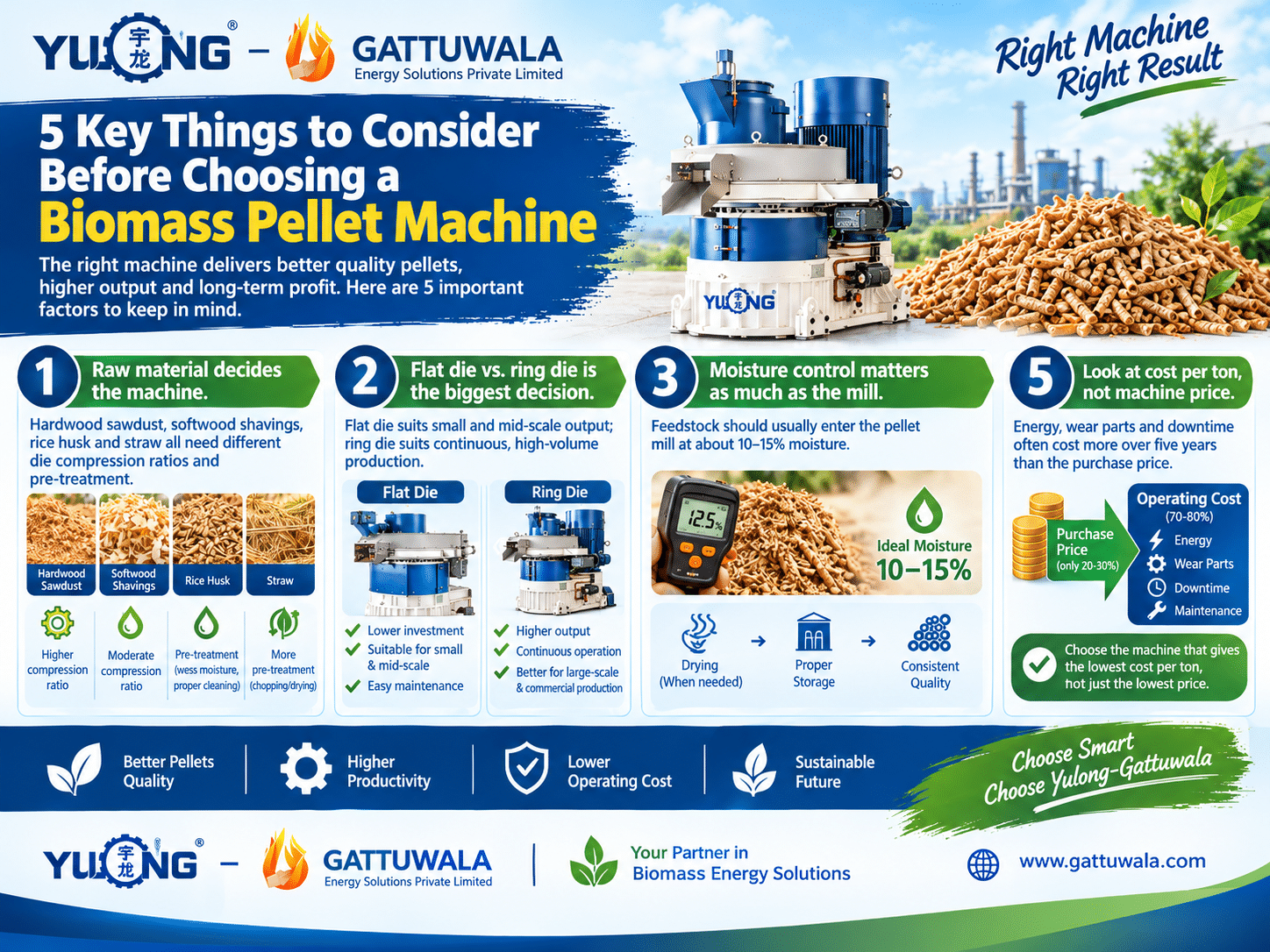
• Raw material decides the machine. Hardwood sawdust, softwood shavings, rice husk and straw all need different die compression ratios and pre-treatment.
• Flat die vs. ring die is the biggest decision. Flat die suits small and mid-scale output; ring die suits continuous, high-volume production.
• Moisture control matters as much as the mill. Feedstock should usually enter the pellet mill at about 10-15% moisture.
• Buy for your market’s standard. If you plan to sell certified pellets (for example ENplus A1), your machine, dryer and process control must support that quality.
• Look at cost per ton, not machine price. Energy, wear parts and downtime often cost more over five years than the purchase price.
What Is a Biomass Pellet Machine?
A biomass pellet machine (also called a pellet mill or pelletizer) compresses ground, dried biomass into dense, uniform cylindrical pellets. Heat and pressure inside the die release the natural lignin in the material, which acts as a binder, so most wood pellets need no added glue.
A complete biomass pellet production line normally includes more than the pellet mill itself:
1. Crusher or chipper (to size raw material)
2. Hammer mill (to grind to a uniform particle size)
3. Dryer (to reach the right moisture level)
4. Pellet mill (the core machine)
5. Cooler and screener (to harden and clean pellets)
6. Packing system (bags, big bags or bulk storage)
When you shop, ask suppliers whether the quote covers the pellet mill only or the full line. This is the most common source of budget surprises.
Step 1: Define Your Raw Material
The feedstock you can buy consistently, and cheaply, should drive every other decision.
• Wood sawdust and shavings: The easiest material to pelletize. Lignin content is high, so pellets bind well.
• Wood chips and logs: Need a chipper and hammer mill first, which adds capital cost.
• Agricultural residues (straw, rice husk, corn stalks, sunflower husk): Lower lignin and higher ash content. They often need a lower-speed mill, a higher compression ratio die, or a binder, and the pellets may not meet premium standards.
• Energy crops and grasses: Variable density. Test before you commit.
• Mixed feedstock: Possible, but blending ratios must be controlled or pellet quality will swing.
Step 2: Flat Die vs. Ring Die Pellet Machine
This is the decision most buyers struggle with.
Feature | Flat die pellet mill | Ring die pellet mill |
Best for | Small to mid-scale, startups | Continuous, high-volume production |
Purchase price | Lower | Higher |
Pellet density and uniformity | Good | Excellent |
Wear part cost | Lower per part, but changed more often | Higher per part, longer life per ton |
Energy efficiency at scale | Lower | Higher |
Maintenance | Simple, easy access | More complex, needs skilled operators |
Material flexibility | Handles varied and moist feed well | Prefers consistent, well-prepared feed |
Step 3: Check Pellet Size and Quality Standards
Customers decide the pellet spec, not you.
• Diameter: 6 mm is common for residential heating and 8 mm for some boilers. Larger pellets (10-12 mm and above) are used for industrial or animal feed applications.
• Certification: ENplus A1 (and the underlying ISO 17225-2 standard) sets limits on moisture, ash, durability, bulk density and calorific value. Buyers in Europe and for export often require it. In North America, look at the Pellet Fuels Institute (PFI) standard.
• Quality indicators to design for: low moisture (around 10% or less in finished pellets), low ash, high mechanical durability, and low fines.
Step 4: Evaluate Energy Use and Operating Costs
Machine price is only the starting point. Compare these running costs:
• Power consumption: Ask for kWh per ton of pellets, not just motor size. Total line consumption is often much higher than the pellet mill alone because drying, grinding and conveying add load.
• Wear parts: Dies, rollers and hammers are consumables. Ask for expected life in tons of pellets and their replacement price.
• Labor: More automation means fewer operators but a higher purchase price.
• Drying fuel: The dryer is frequently the largest energy cost in a line.
• Downtime: A cheaper machine that stops often can cost more than a reliable one.
Simple formula: Cost per ton = (energy + wear parts + labor + maintenance + raw material) divided by tons produced. Compare suppliers on this number across a five-year view.
Step 5: Compare Suppliers, Not Just Machines
A strong supplier reduces your risk more than a strong spec sheet. Check:
• Track record: Ask for customer references in your region and similar feedstock.
• Material testing: Will they run a trial with your sample?
• Core component quality: Gearbox, bearings, motor brand and die steel grade.
• After-sales support: Local engineers, spare parts availability, response time and training.
• Warranty terms: What is covered, for how long, and what voids it.
• Compliance: CE marking, safety standards and electrical certification relevant to your country.
• Installation and commissioning: Is it included?
Step 6: Plan for Space, Power and Safety
Before you sign a purchase order, confirm:
• Site layout: Room for raw material storage, the line, finished pellet storage and truck access.
• Power supply: Voltage, phase and capacity. Many ring die lines need a heavy three-phase connection.
• Dust and fire safety: Biomass dust is combustible. Plan for dust collection, spark detection, ventilation and fire suppression, and follow local explosion-protection rules.
• Permits: Environmental, emissions and local business licenses.
• Noise and vibration: Foundations and enclosures may be needed.
Frequently Asked Questions
For most small businesses producing up to about 2ton per hour, a flat die pellet mill is the best starting point. It costs less, is simple to maintain and handles varied feedstock. If you plan to scale above 1 ton per hour, consider a ring die pellet mill.
Prices vary widely by type, capacity and country of manufacture. Small flat die machines can cost a few thousand dollars, while a complete industrial line can cost hundreds of thousands. Always request an itemized quote covering the pellet mill, dryer, cooler, screener, packing and installation.
Most biomass should enter the pellet mill at roughly 10-15% moisture. Too wet and the pellets crumble or the die blocks; too dry and the material does not bind properly. Finished premium pellets are generally around 10% moisture or lower.
Yes, but not always with the same die. Different materials need different die compression ratios and settings. Many producers keep a spare die for each feedstock type, or blend materials in controlled ratios.
Die life depends on the material, abrasiveness (sand and soil contamination shorten it), operating practice and steel quality. Ask your supplier for expected life in tons of pellets for your specific feedstock, rather than relying on general figures.
It can be, when feedstock is cheap and consistent, energy costs are controlled and there is a reliable buyer. Profitability depends heavily on your local market price for pellets, raw material cost, and cost per ton of production, so build a realistic financial model before investing.
Not everywhere, but many buyers in Europe and for export markets require it. It also gives you a clear quality benchmark and helps you charge a premium. Check the requirements of your target customers first.

Biomass Pellet Machine Manufacturers & Suppliers in India
Best Pellet, CBG & Solar Plant Manufacturers in India